Dry-type Spent Nuclear Fuel Storage Facility of ChNPP (ISF-2)

In order to implement the Chernobyl NPP decommissioning program, a decision was made to build an interim dry-type spent nuclear fuel storage facility (ISF-2). In contrast to the wet-type spent nuclear fuel storage facility (ISF-1) intended for storage in the spent fuel storage pools of Units 1, 2, 3, which was put into operation in 1986 and whose service life, based on the results of the safety reassessment, ends at the end of 2028 year, ISF-2 is safer and has a longer period of storage.
In 1999, a contract for the construction of ISF-2 was signed with the Framatome concern, which in 2005 became part of the Areva NP concern. Construction of ISF-2 was financed from the nuclear safety account of the European Bank for Reconstruction and Development.
The construction was planned to be completed in 2003, but in the same year the ChNPP discovered deviations from the terms of the contract by Framatome. Due to design shortcomings, the main problem of drying spent nuclear fuel (SNF) and removing water from leaking fuel elements (FE) was not resolved, so the contract with Framatome was terminated.
In 2007, a new contract was signed with the American company Holtec International for the construction of ISF-2.
According to the project, ISF-2 will provide reception of 2,500 spent fuel assemblies (SFAs), their preparation for storage and long-term storage for 100 years of approximately 21,000 SFAs of RBMK-1000 reactors.
ISF-2 consists of (Figures 1 and 2):
- Spent Fuel Processing Facility (SFPF);
- Spent Fuel Storage Area (SFSA).
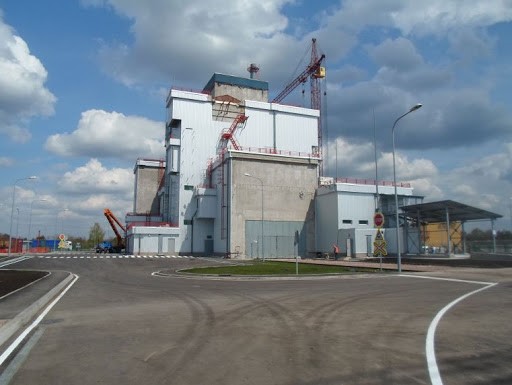
Figure 1 - SFPF
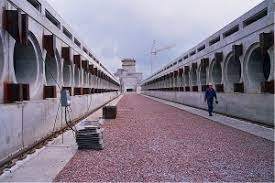
Figure 2 - SFSA
According to the design, SFAs from ISF-1 will be delivered to SFPF in transport containers (once a week). The design capacity of the transport container is 9 SFAs. Based on these data, the transfer of SFAs from ISF-1 to ISF-2 will be carried out during 10 years.
In the SFPF building, the transfer basket with 9 SFAs will be removed from the transport container and placed in one of the wells of hot chamber (Figure 3).
The SFA consists of two bundles of fuel elements and an extension rod, which are cut using a cutting machine and placed in special tubes for FEs. Further, special tubes with FEs are loaded into a metal double-walled dry shielded canister (DWC), which holds 186 tubes with FE bundles or 93 SFAs.
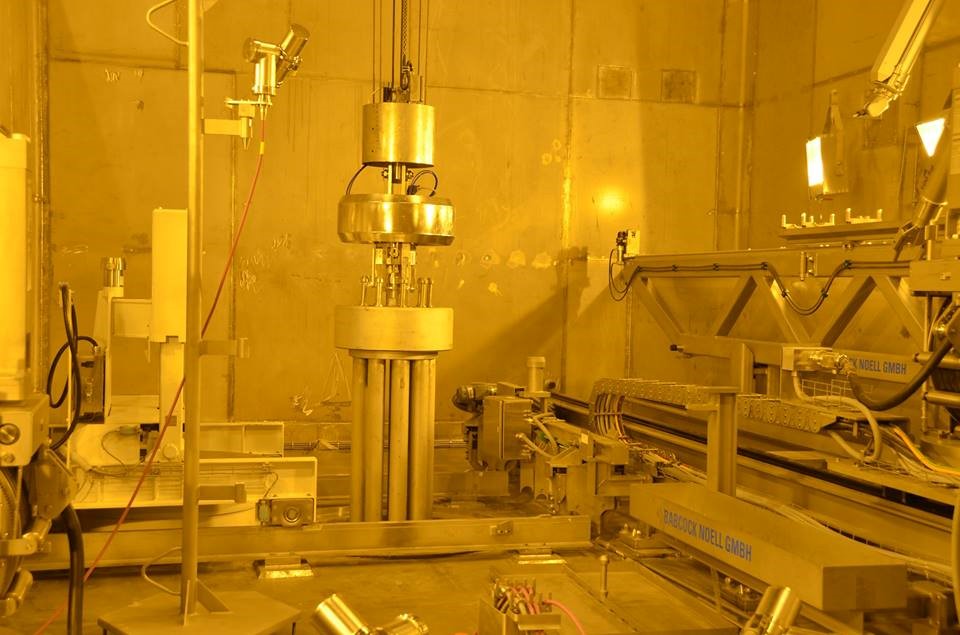
Figure 3 – SFPF hot chamber
After full loading of DWC, the tubes with fuel elements are dried with the help of a forced gas drying system to remove the remaining moisture. After completion of drying cycle, DWC is sealed with lids and filled with a helium inert gas.
After that, DWC is transported from the SFPF to the SFSA, where it is loaded into a separate concrete storage module (CSM) (Figure 4). For 100 years, CSM will provide the controlled storage of SFAs with passive removal of excess heat from spent nuclear fuel, while DWC throughout the entire storage period will ensure SNF isolation from the environment and resistance to any extreme natural and technogenic impacts.
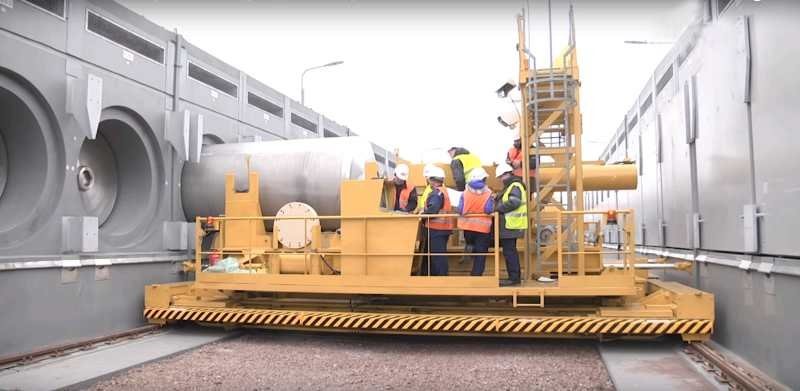
Figure 4 – Loading DWC into the concrete storage module
In 2019, “cold” tests were carried out, which are a necessary part of the ISF-2 pre-launch tests and consisted of 3 main stages. At the first stage, the operability of equipment of all major technological systems and their ability to handle SFA simulators were tested. At the second stage, all auxiliary systems that ensure the operation of the main ones were tested. The third stage of cold tests was aimed at determining the maintainability of all ISF-2 equipment, whether its units and parts can be repaired remotely (without direct participation of personnel) in the event of their failure under ISF-2 operating conditions.
All three stages of tests were supervised by a commission consisting of representatives of the contractor, customer, and SNRIU. As a result of the tests, the commission made comments that were later eliminated.
At the beginning of 2020, after the completion of all construction and installation works, the ISF-2 was officially handed over from the contractor (Holtec International) to the customer (ChNPP). And at the end of January 2020, the ChNPP obtained from the State Architectural and Construction Inspectorate the certificate on dry-type Spent Nuclear Fuel Storage Facility construction completion.
This became the basis for preparing the ChNPP for the stage of “hot” tests in accordance with the test program agreed by the SNRIU. Special attention will be paid to biological shielding during “hot” tests. All operations on “hot” tests should be performed by the ChNPP personnel under the supervision of the Holtec International personnel.
At the beginning of September 2020, the ChNPP obtained a separate permit from the SNRIU for the implementation of ISF-2 commissioning activities. Obtaining the permit will allow starting “hot” tests with real spent nuclear fuel in the amount of 93 SFAs, which will be transported from ISF-1 to ISF-2, where it will be properly prepared, placed in DWCs and loaded into concrete storage module.